Saturday, April 6, 2019

Early Days on Bonaire

Bonaire, Dutch Caribbean

[Note: we are not quite done with our Mexico posts, but wanted to post something about Bonaire before we leave!]


After about 15 months in Mexico, we moved on to the Caribbean island of Bonaire in mid-January, to scratch the dive itch. Bonaire is about 50 miles north of Venezuela, one of the ABC Islands along with Aruba and Curacao, and known as one of the best, if not the best shore diving locations in the world. We had vacationed here twice before, in 1997 and 2002. We decided to spend about 4 months here to see if we get tired of diving, when we could dive about any time we wanted to, and for not that much money.
There are about 200 of these identical trucks....
We are renting a dive truck, which is basically a 4-door truck with a wooden pallet in the back, sized for carrying scuba tanks. On the one hand it is about $26 per day, not so bad, on the other hand, over a month that adds up to $800. Tanks cost $8-14 each, so all in still a lot cheaper than boat diving, and more flexible. With the flexibility comes more responsibility. On a boat we generally follow a divemaster on a profile they have used, so don’t have to pay too much attention to navigation, etc.


From the shore, though, you are in charge of everything, set up, break down, navigation, reading surface conditions and current, safe entry and exit. With the ironshore (rough coral and rock) here, miscalculating the exit, even in a pretty calm ocean, can result in some shin and finger damage. Yes, that happened on Day 3. Don’t turn your back on the ocean! There is a reason crabs walk sideways.


We are renting an apartment in a local neighborhood – our landlady, and both neighbors are Bonairians. We have 3 large iguanas that live on the back fence, a tamarind tree which at least on full moons (one so far) is home to some yowling cats (which have had a few buckets of water sent their way at night). 

Lora (from Bonaire Birders website)
There are also many lovely bird songs, and so far we’ve identified a few birds, yellow orioles, saffron finches (yellow with saffron colored eyeliner), mockingbirds, ground doves, and unique to Bonaire – yellow-shouldered Amazon parrots (that hang upside down on the telephone lines – because they can!).


The washing machine on the large back porch is a model of customization, sort of. We fill the main tub with a garden hose, to fit the load, wash, remove laundry to a small side basket, rapid spin to drain, then back in the main tub, more garden hose, for rinsing, then once more in the spinner. Kind of like the run on George Bailey’s bank – use only what you need. The trade winds blow pretty much 24/7, the air is very low humidity, and the back clothesline, where we double down on clothespins due to the wind, dries things wicked fast.


The apartment has no hot water, but due to the warm climate, usually 80s during the day, that is not much of a factor. We also have repurposed a few 1-liter plastic bottles with water, solar heated on the front porch, which make for a nice if brief hot water indulgence after the tepid shower. We’ve also been taking 1-2 bottles on our dives, leaving them on the dashboard in the sun -- free hot water rinse after diving! That and an icy Amstel (not Light, the real kind) is Mark’s happy place.


Why did we wait so long? Life gets in the way if you let it.

The Dutch have a thing for mayonnaise...!?!
Bonaire is a Dutch island, having changed “ownership” multiple times over the past 400 years. The Dutch influence means good cheese, good meat, and good road signs. Unfortunately, it also means (well, not sure about the connection, but…) high prices. We have serious sticker shock after 1+ years in Mexico. Groceries, some are pricey, some not so much. Rum - this is the Caribbean, right? – they have decent choices from Cuba and Venezuela and the DR, but they are expensive. Eating at a restaurant, early days but it is easy to spend $70 US for not that much.
aka topes in Spanish

Bonaire drivers are in general terrible, be they local or Dutch expats. (sorry, but!) Compared to Mexico, supposedly known for crazy behavior…no contest. Bonaire is worse.


Mark vs the mosquitos
We’ve been visited by a few plagues so far. First was mosquitos, which we thought we sorted out but continue to battle, having become quite adept with the electric tennis racquet zapper. Next was what Google said were Indianmeal Moth larvae. Small white inchworms, no idea where they came from (other than mature Indianmeal Moths?) One day and they are now gone. And, of course, ants. They even found our leftovers in our truck and swarmed. Ick. Yay, bug spray! 3 down, 4 to go, if Moses shows up. No cucarachas so far, knock on wood.

Heeere they come!! (cue scary music)
we love carrots!! oh look what just hit me in the nose!

We went to the Bonaire Donkey Sanctuary. It was a hoot. The word in Papiamentu for thank you is danki, a homophone for donkey. Suffice it to say the animals are awesome, if legion (700+), and we laughed a lot. They watched us get out of the truck, but knew the carrots were inside, so surrounded and stared at the truck for 10 minutes while we climbed the observation tower. Reminded us of that movie, Men Who 
Stare at Goats....but Donkeys Who Stare at Truck may not do as well at the box office. We can also now find our truck in the parking lot thanks to donkey snot on the windows!
There are carrots in there!!


Super aqua man? 
But what about the diving, you say? It is FANTASTIC. Ok, can we tell that there is more damage and algae than our first trip here 22 years ago? Yes. Is it a shame that they now allow cruise ships here? Yes. But for the most part there are lots of fish, quite a bit of good coral and sponges, and lots to look at.


In fact, we got an underwater camera/ flashlight combo which Linda has been playing with to some good results. It takes an extra step or two to process the pictures to tone down the blue in the pictures, but it’s been pretty cool to have pics to show others some of the cool stuff under the water.


We are still trying to sort out what the Marine Park fee accomplishes ($45 per year per person), besides paying the salaries of the rangers (which we never see on the water). Also of note, the cruise ship folks pay no park fee, they hit and run on the reef (often terrible divers,) while the cruise ships are happy to pay the smallish fine if caught dumping off the coast as they leave. It is a very non-ecofriendly operation.


Update: As for the experimental test of diving interest part of the sojourn, at 76 days we’ve done 75 dives. And not bored yet! And we each hit our 400th dive a couple of weeks back. 

2019 maart / marzo


Sunday, March 31, 2019

You say DF, I say Mexico


Mexico City, CDMX, DF, Mexico


Mexico City…an astounding metropolis that goes by many names, and to contradict Bill Shakespeare, it warrants ALL the names to reflect its many sights, sounds and smells.

Mexico City, la ciudad de Mexico, can also be called: Distrito Federal, DF (day – effay) and, simply, MEXICO. As you drive around the country you constantly see highway signs pointing to “Mexico” which can be a little puzzling at first, until you realize that mexicanos refer to the capital city as simply “Mexico.”

The founding of the city IS the founding of Mexico. Legend has it that after the fall of the Toltec Empire around 1000 ce, the Aztecs were looking for a new home. They were told by their main god, Huitzilopochtil, that they should look for a sign…an eagle on a nopal cactus with a snake in its beak. Pretty specific. Pretty unusual. This is the symbol on the Mexican flag. 


They found that eagle (and nopal and the unfortunate snake) on an island in Lake Texcoco. This unlikely location was indeed confirmed by their god (really?). They founded Tenochtitlan, and immediately outgrew the island. It kept growing and growing…and the Aztecs kept expanding their empire from sea to shining sea. Until Cortes showed up 1519. And that, they say…was the end of that story. However, the City lives on.

Mexico City is huge. Depending on how you count and which Wiki post you trust, somewhere around 8.84 million, and 21.3 million (greater metro area) people live here. It is the 2nd largest city in the Western Hemisphere, after Sao Paolo. It is divided into 16 boroughs (one of which, incidentally, is the title of the movie, Roma.)
We wanted to have enough time to soak in a decent start to a huge and fascinating city, so scheduled 3 weeks there from just before Christmas, through New Year’s and Dia de Tres Reyes (Three Kings, of Christmas carol and rubber cigar fame).  It was an amazing visit. An indicator is that Linda’s edited down photo count is ~1300!

Our home base was in el Centro, an apartment across the street from Parque Alameda, the oldest park in DF, dating back to the time of Cortes. This turned out to be a great central location, a short walk to the Palacio de Bellas Artes, an absolutely gorgeous Art Deco (inside) and neoclassical (outside) building started around 1904, stopped due to foundation problems, then the Revolution, and restarted, then finished in the mid-1930s.

We had heard that a lot of chilangos leave the City for the holidays (though how many out of 25 million makes a noticeable difference?), so things might be a little less crowded. We saw days where that seemed true, and others where we wondered how many people could walk abreast down a wide, crowded sidewalk.

On the upper deck. Mind the wires!
After getting settled and provisioning our apartment, we started our introduction with a narrated bus tour, yes…those silly double decker buses. They have audio in 9 languages (including Russian, in case Paul Manafort shows up), with your own headset. Mark’s earphones shocked him every time he moved in the bus seat (think your older brother rubbing his feet on the carpet but touching your ear!) It was a GREAT introduction to the city and who knew that the music was going to be so good? 

We were also not too far from the Zocalo, THE central square of DF. This is the site of the Metropolitan Cathedral, as well as the Palacio National, first built by the Spanish. The cathedral was begun in 1573, and, it turns out, that construction was more or less on top of the original Aztec site, the Templo Mayor, using most of the stones from the original Templo to build the “new” one.

It being Christmas, the Zocalo was heavily festooned with huge lights and finery, large sparkly wreaths and candlesticks and flores de noches buenas. People were everywhere most of the time, including vendors of food and about anything else you could imagine other than large appliances. There were people dressed in – Azteca costumes, with long pheasant feathers, doing purifying rites with copal, with lines of people hoping to start the new year purified.

The streets were jammed with vendors who put their merchandise on the sidewalks and streets, making just walking a challenge. The merchandise is moved around by diableros, men with hand carts stacked high, carrying mostly boxes that say Hecho en China, total loads weighing over 1000 pounds. Amazing.


Adelitas
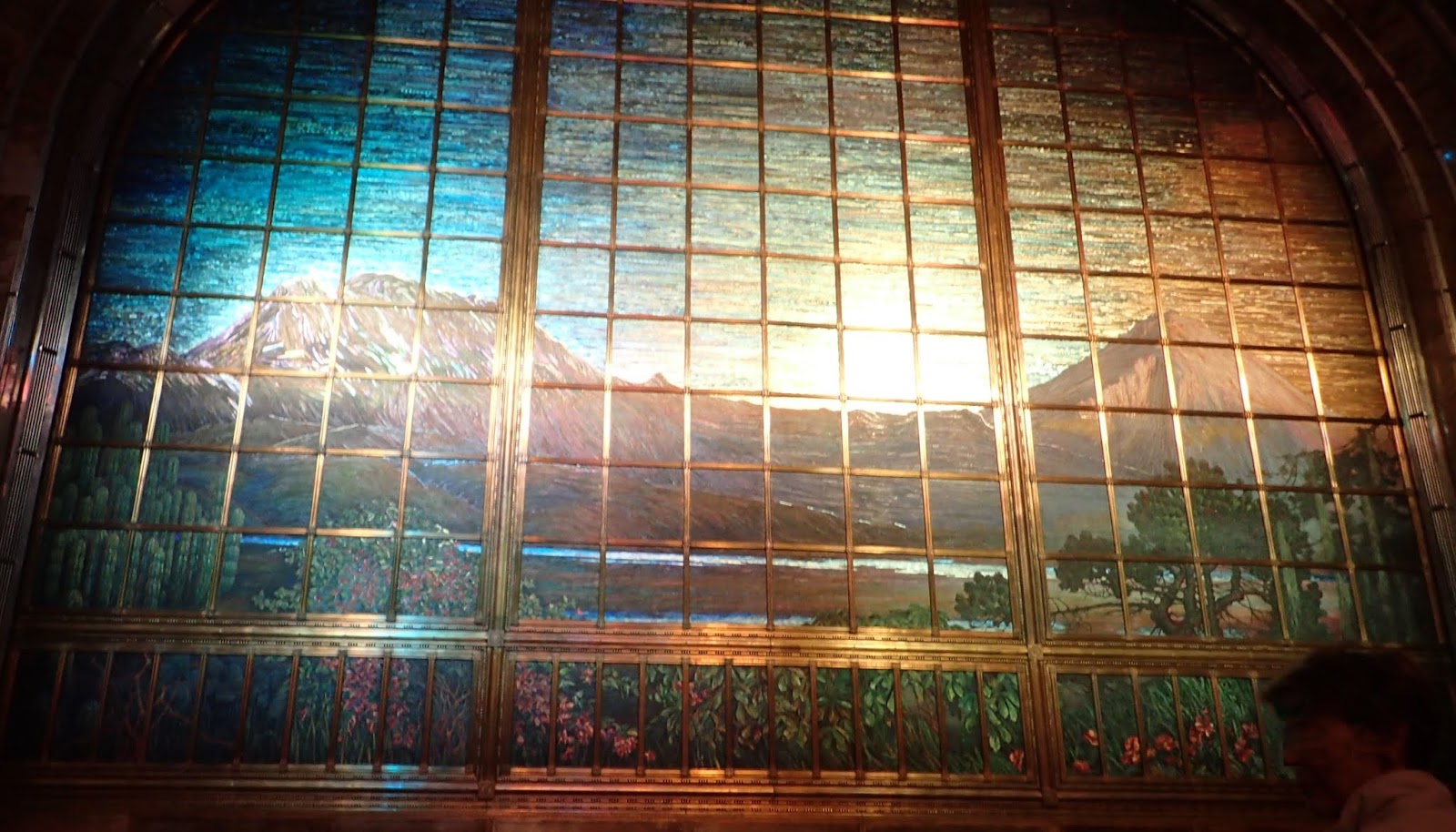
A former colleague of Mark’s happened to be visiting DF with her family for the holidays from Switzerland, and they suggested seeing the Ballet Folklorico at the Palacio de Bellas Artes…. and are we happy she did! It was amazing, and totally worth the $55 per person for up close seats. Just seeing the inside of the theater was a treat, as the “curtain” is a metal panel weighing 24 tons, made by Tiffany, designed by the famous Dr. Atl (later post), with over 1 million (!) pieces of colored glass. Just one more example of trying to take in the magnitude and scope of Mexico City. The program started with indigenous drum songs and dances, and went through various cultural and regional music and dance, right up to mariachis. Viva Mariachis!

Teotihuacan

Temple of the moon
We hired a tour guide for our group of 4 adults and 4 kids to tour the ancient ceremonial city population 125,000. Established 100 BCE, it was according to NatGeo, probably the largest city in the Western hemisphere before 1400. Who built it is not known for sure, but apparently it happened before the peak of Toltec power. Then around 550 CE it was systematically sacked and burned – our guide said by the poorer classes, but no one really knows. 
Jobu got to the pyramids
When the Aztecs found the city in the 1400s naming it Teotihuacan (meaning “the place where the gods were created” in Nahuatl), the city had been abandoned for centuries. Its prominent features are a massive Temple of the Sun, and slightly smaller Temple of the Moon. The site is also a weapon of math instruction – the number of steps and other things all revolve around the founders’ calendar, reminiscent of but pre-dating the Maya.

Xochimilco

Remember that island in the lake that Mexico City was founded on (not to be confused with Swamp Castle)? Well, there are still floating gardens, called chinampas, a sort of early but effective eco-garden, created by the Aztec to expand useable space, including land to grow food. 

Much of Xochimilco is devoted to a touristy boat trip with 15 of your best friends and about 100 other boats. The canals were so packed with pole boats, each with a long picnic table and about 20 small chairs, that we probably only moved maybe 100 yards over the course of an hour, It was hard to tell, but it was a classic cluster, and we were in tears laughing. 


Mariachis (with badly tuned instruments), ladies cooking tortillas, guys playing marimbas (also out of tune), souvenirs, sombreros - all on smaller flat-bottomed boats that tied up to you if you wanted something, Pure, unadulterated, how-in-the-hell-do-the-Mexicans-do-this joy (for us anyway). You have to see it to believe it.

 At the end of the boat tour, we were sitting on short wall waiting for the bus to go to the next place, next to a Mexican lady selling necklaces. She held them up to us, we politely declined, then we offered her a cookie out of our ziploc lunch bag. She took one then started talking to us in Spanish. As usual, Mark got maybe 1/2 of it, Linda got 80+%, and we talked for only a few minutes in Spanish. But she was very kind and smiled and it made it all worth "taking the chance", which is after all only one of not understanding all the words. Viva Mexico. If you take nothing else from our blog…take the chance!

Museums, museums everywhere


It seems like there are more museums per square…anything than just about any city except D.C.
It's not a calendar!
not gonna say it....
The Big Kahuna of museums in DF is the Museo de Anthropologia. It is so large and so detailed that we took parts of 2 different days to see it, and even then probably only scratched the surface. There is the huge and well-known Piedra de Sol, usually referred to incorrectly as the Aztec Calendar. Modern archaeologists believe it is likely to have been used primarily as a ceremonial basin or ritual altar. During the Mexican-American War, soldiers of the United States Army who occupied the plaza used the Piedra del Sol for target shooting. Geez, Louise. [Tip: if you get there and there are lines at the ticket booth inside, look for the automated ticket kiosk over near the gift shop. No line!]

Chapultepec garden gate

jumping to escape the Americans
We visited Castillo Chapultepec, which is beautiful. In 1846-47, it was a military academy, and was the place where 6 young cadets threw themselves from the parapets, wrapped in La Bandera de Mexico, to escape the marauding Americans (who were after, among other things -- California, Texas, NM and AZ) and become immortalized as the Ninos Heroes. Virtually every pueblo in Mexico has a street named Ninos Heroes. Later the ill-fated Hapsburg emperor Maximillian lived there, then later still, the president- dictator Porfirio Diaz. A decent amount of bad karma.

Muertos bull ring, so detailed!
completely covered in Huichol beading
Regional dresses, beautiful!

Probably our favorite museum was the Museo de Arte Popular (Folk Art), near our apartment. It has four floors of displays, including woven fabrics, the awesome beadwork of the Huichol, fantastical Oaxacan alebrijes, many different art pieces made for Dia de Muertos, and Mark’s favorite, the display of “typical clothing” from many of the indigenous peoples still in Mexico. And … free if you have Mark’s Mexican Old Guy (INAPAM) card! (60 years old and up)


Frida's blue house


We also visited Casa Azul, Frida Kahlo’s home in Coyoacan, and the Diego y Frida House in San Angel, designed in Bauhaus style by Juan O’Gorman (O’Gorman also lived there). There are 3 separate residences in the compound. 
Frida, Diego and Juan's houses

Not too far away is the house where Leon Trotsky lived, and at which was later assassinated in 1940. Not knowing much about Trotsky until we got to DF, it is a fascinating place. If you plan to go, read Barbara Kingsolver’s La Lacuna first. In fact, just read it anyway.

A must-see is the library building at UNAM, (Universidad Nacional Autonoma de Mexico, 350,000 enrolled!), in the vicinity of Casa Azul, the library is about 8-10 stories high and covered on all 4 side by mosaics designed by Juan O’Gorman. Study up on your Mexico history before you go, and either get a knowledgeable guide to explain the murals, or do some homework – your effort will be rewarded. It is fabtastic. We think if O’Gorman had a little better PR about 90 years ago he would be thought of on a par with Diego Rivera. There will also be a separate blog post on The Muralists. You could spend a solid week just searching out murals and learning of their symbolism.

Whew. Sorry for the long post, but it reflects the size, density and complexity of CDMX!

2019 enero

Thursday, March 14, 2019

Basilica de Nuestra Senora de Guadalupe

DF, Mexico


When we moved to Mexico, we noticed how prevalent the image of the Virgen de Guadalupe was. She is on many walls in Lake Chapala, and there are small shrines to her under trees and on corners, usually well-tended, with candles, etc. We witnessed the great desfile (parade) on her Saint Day, 12 December. It motivated us to read more about her and try to understand why she was so important to Mexico – we have read that Mexico is 90% Catholic, but 100% revere Guadalupe.

Purifying incense in the crosswalk on the way

One puzzlement – especially for us fallen organized religion folks – is she the Virgin Mary, or another person? There are a lot of Virgins in Mexico - de Soledad, de Dolores, etc. 


Add caption
Several books and lots of internet searches later, the answer appears to be she is indeed supposed to be the Mother of Jesus (this may sound really sophomoric to a lot of folks!), but a more “Indio” version who appeared (4 times) to an indigenous man, Juan Diego, in 1531 on Tepeyac Hill, north of Mexico City (but now within the sprawling metropolis).  

Guadalupe asked Juan Diego to tell the local Catholic authorities that she wanted a church built in her honor on the site – which was met with much skepticism from said authorities, so she eventually provided Juan Diego with her apparition on his cloak, along with many Castilian roses (neither native nor in season), which he presented to the Bishop. Game, set, match to Lupita! (her nickname)
The plaza
Walking toward the Basilica


One of the must-do items in Mexico City is to visit said historic Hill.... Tepeyac is believed to have been a Pre-Columbian worship site for the indigenous mother goddess Tonantzin Coatlaxopeuh. Guadalupe had brown skin, like the indigenous Mexicans. She appeared to a paisano, and spoke to him in his native language, not Spanish.

The location is now chock-a-block with shrines and churches and cathedrals, the first built in 1660, the most recent in the 1970s. The latter can seat 40,000 people, and they hold mass on the hour every day from 6 am to 8 pm (in the main Basilica). Mass Around the Clock!


The actual cloak, called the Tilma, is in a silver and gold frame above and behind the main altar where the masses are held. They have created a four-lane, airport-like people-mover underneath and behind the altar so that the thousands of people who come to see the Tilma every day (4 million visit the shrine annually, so about 11,000 per day on average) can do so, without disrupting the mass, maybe as many times as they want to pass as long as they are wiling to get back in line. This approach means no one can crowd around it, take selfies, and generally make it impossible for others to see. This process would make Walt Disney proud.


Get your Maria here
In any case, as you might imagine you can buy about any Guadalupe-related thing there, statues of all sizes (of course) and reproductions of the Tilma, in frames and not, candles, snow globes, mouse pads (seems wrong to click on Guadalupe!), refrigerator magnets. 

That said, the coolest souvenir maybe ever costs 11 pesos (55 cents or so). The vendor puts a one-peso coin into the turn-the-crank coin crusher, and viola! You have a bi-metallic Guadalupe medallion made from your peso! And the bi-metallic peso is way better than a penny (sorry, Abe!)


Capilla marking the spot
Bit of a climb to the hilltop
There are many other buildings to see on the grounds, a capilla built in 1660 on the actual location where the discussions with Juan Diego took place, another church built in the late 1700s (and visited by Morelos!) that covers the miraculous spring that appeared (thanks again, Lupita!).


Freebie, no charge


There are several vendors who offer you the opportunity (for 50 pesos) to have your picture taken in front of the statue of La Virgen, or sitting on a fiberglass horse, or both.

Back to the miracle of 1531. As already mentioned, the location of El Milagro was on or near a site previously sacred to the indigenous people. La Virgen had brown skin. She appeared to an indio. Other indigenous traditions that were co-opted by the Spanish and the Church – moving the traditional date of the indigenous ceremonies honoring the dead from August or so to coincide with the Church’s All Saints Day in November; melding the winter solstice on December 21, important to agrarian societies in Mexico, into the Christian Christmas of December 25; etc. etc. It is also interesting that the image of Guadalupe is depicted standing on a crescent moon – the symbol of Islam and the Moors who ruled Spain for 500 years (from 711 CE) – interpreted by some as showing the superiority of Spain and Catholicism over Islam.

Faith and belief, if you have them, outweigh any such considerations, and maybe it is not fair to marvel at the colonial architecture and churches and at the same time be cynical about the (presumed) manipulations by Spain and their religion of the local population. And we’re not even talking about the Inquisition. However, at the famed Museo Anthropologica, we noted many times that the varied cultures of Mexico had adopted and adapted Catholic rituals into their own local customs. Even literally burying their own gods and images (which the Catholics tried to banish) underneath the Catholic versions, so they could appear to be worshipping the “correct” god. We definitely admire the creative approach.

So, you may well ask, what do we believe about Maria de Guadalupe? We believe in the indomitable human spirit, and in the concept of a kind yet firm, loving mother who looks out for us. And we especially love how Mexicanos love her, and keep hope in life through her, in what can be very difficult lives to live.

(...And we named our little car which sports a Guadalupe decal, after her. And Mark carries a prayer card of her. And Linda has a necklace of her…hmm....)

enero 2019