Showing posts with label Jalisco. Show all posts

Wednesday, April 17, 2019

The Muralistas of Mexico ... and New Hampshire

Mexico and Hanover, New Hampshire

Dartmouth Orozco
While we were at grad school in New England, we discovered there was a well-known, and controversial (at least back when they were made) set of 24 mural panels in Baker Library, created by a Mexican artist named Jose Clemente Orozco (1932-34). They cover a history of Mesoamerica, from the Aztecs to the then-modern industrial society of the 1930s. Even with no training or background in this art, we found them striking – they tell a story you can start to follow, without knowing all the players or facts. Even better that they upset certain folks of the Dartmouth Establishment back when they were created.


We don't have a favorite! (Guadalajara)

We had a brief introduction to Mexican muralists during a tour of Guadalajara, but Mexico City is knee deep in murals from some of, if not THE greatest muralistas ever – Diego Rivera, David Siqueiros, Juan O’Gorman, Jose Orozco, and Dr. Atl. So we made it a part of our 3-week sojourn in DF to find many of these public works of art, and to try to learn more about the stories they tell, and the people who created them. 


One thing to consider is that muralistas were also moralistas of a sort. They had a story to tell, based on facts but like any history also imbued with their take on what it all meant.


Diego's version of Posada's Catrina
Mural painting in Mexico started in the 1920s, after the Mexican Revolution, generally with social and political messages. It was supported by the Mexican government as a way to unify the country in post-Revolution times. Even before the Revolution, Jose Guadalupe Posada created the now-famous image of Catrina, which graces much of Dia de Muertos art. Posada was making fun of the European influence on Mexican elites at the turn of the 20th century.


The first modern muralista was Dr. Atl, born Gerardo Murillo Cornado in 1875. Atl, the Nahuatl word for water, believed that Mexican art should reflect Mexican life and values. He convinced President Porfirio Diaz that too many Mexican artists were trained in a classical way which simply mimicked European culture. By putting art large in public spaces on walls of buildings, Mexican artists could be liberated from this approach, while teaching and inspiring the people of Mexico.


Dr. Atl, photo by Tomas Montero Torres

Orozco was from Jalisco
Dr. Atl also did a series of famous paintings (which we were lucky enough to stumble cross in a museum in Morelia) of the 1943 eruption of Paricutin, which literally grew from the earth. He was injured while observing the eruption and his leg was amputated. He was the teacher of another muralista, the aforementioned Orozco, who ironically lost his left hand at age 21 building fireworks. Atl also wrote a short story called La Perla, which inspired a story of similar title from John Steinbeck later, a book which Orozco illustrated. 


Man on Fire
Orozco’s best-known work is a set of 57 murals in the Hospicio Cabanas in Guadalajara. We had a very good tour there, and literally got sore from craning our necks to look at all the works on the ceiling.

Diego's dream of a Sunday afternoon in the Alameda central park
Diego Rivera is probably the best known of the painters. His best known work to us is Sueno de una Tarde Dominical en la Alameda Central. It was originally in a hotel near its present location at the Museo Mural Diego Rivera in Mexico City. The 1985 earthquake destroyed the hotel but miraculously the mural was mostly unscathed, and moved to the Museo. We spent a long time at the “key” to who all the people are in the painting, and if you took the time to place them all, you would have a great start in learning the history of Mexico!
Diego in Palacio Nacional. Amazing.

Rivera was, of course, married (twice!) to Frida Kahlo, and lived for a time in a compound, designed by O’Gorman (another muralista) with Frida and O’Gorman (in 3 separate houses). He has other huge and detailed murals in many places, our favorite aside from Suerte was at the Palacio Nacional on the Zocalo. There is also a huge collection of Rivera murals at the Secretario de Educacion. They are all worth the effort to find them.

Oh boy! O'Gorman!

Juan O’Gorman’s murals in the Chapultepec Castle are vivid, detailed and striking. This is the place from which the Ninos Heroes leapt to their death during the American invasion in 1847. Perhaps his most famous work is the Central Library at Ciudad Universitaria at UNAM. His mosaics cover the 4,000 square meters of the four faces of the building and are made of stones from all corners of Mexico, which O’Gorman traveled extensively to find the colors he wanted. In case you are wondering, his father was Irish (and a painter) and his mother Mexican. It covers pre-Hispanic history all the way to the present, and to see the scale and detail in person is nothing short of jaw-dropping. 

Siqueiros' Torture of Cuauhtémoc (by Cortez of course)
David Siqueiros – He has a definite dramatic style. Interestingly, he fought in Spain against Franco in 1938, and in 1940 he attempted to assist Stalin by assassinating Leon Trotsky, who had been granted asylum in Mexico. Trotsky was a friend of Diego and Frida (and apparently a very good friend of Frida for a while).

Keggy the Keg
So back to Hanover, NH. After the Orozco murals were completed, there was a hue and cry from Dartmouth alumni (the College was all male until 1974) about the controversial nature of the Orozco’s content. It was perceived as critical of institutes of higher learning, and Western civilization.

The "better?" replacement...Hovey 
An alumnus who worked as an illustrator proposed a set of murals, more “Dartmouth in character”, based on an old Dartmouth song, written by Richard Hovey – titled Eleazar Wheelock (founder of Dartmouth in 1769). Among other things, “Eleazar went into the wilderness to teach the Indian…with 500 gallons of New England rum.” The murals, sort of Maxfield Parrish in style, were approved and painted in the faculty dining hall. They are quite interesting, and also basically portray the Indians in ways less than flattering. Dartmouth was known as the Indians until the mid-1970’s when it was replaced officially by the color green, and unofficially by Keggy the Keg. Nowadays, the Hovey Murals are kept on the wall but under wraps except for occasional viewings by the public.

Yes, that's FDR...Pointed commentary, eh? (Orozco)
Why are murals so striking?  Such oversized public pieces of “enduring" art tell a story, even to the illiterate, and make a statement, often controversial, that reflects the times and thinking at that time, while also evoking universal themes: justice, injustice, hopes and dreams. While taking our breath away at the sheer scale of the statement.


2018 diciembre y 2019 enero

Thursday, December 6, 2018

You say Tequila, I say Mezcal

Mezcal Tour, Oaxaca State, Mexico


The people of Oaxaca are very proud of their traditions, many of which are unique within Mexico. Mole (there are 7 kinds), and mezcal are two of the better-known ones. We decided to take a full day tour of several palenques (the places where they make mezcal) with a local expert, a gringo who has lived in Oaxaca for a long time and devoted his “retirement” to spreading the mezcal gospel.
About Mezcal:
Mezcal is made in 9 specific regions of Mexico: Oaxaca, Durango, Guanajuato, Guerrero, San Luis Potosi, Tamaulipas, Zacatecas, Michoacan, and Puebla.  Oaxaca is the center of the mezcal world, responsible for 85% of all mezcals.

First, a quick description. Mezcal is a distilled spirit made from a wide possible array of agaves. The predominant variety of agave used is espadín, in part because of its shorter growing period (~8 years vs. 15 years) and its higher carbohydrate content, so it takes 12-15 kg (~30 lbs) of espadín hearts to make 1 liter of mezcal, compared to maybe 30 kg (~60 lbs) of variety tobalá.

Long day of tasting...just starting!
SO – the more familiar tequila is a mezcal, but made only from 1 species of agave, agave tequilana, or Weber blue agave, and it takes only 7 kg to yield 1 liter. If you get mezcal in a US bar or store, it may say 100% maguey, rather than agave. As best we understand, maguey is just another, maybe Zapotec-based word for agave.

Our tour:
Horno earth oven
Our trip started at 8:30 am, when 19 of us piled into a large van and headed south, to the heart of mezcal production in Oaxaca. Our first stop was at the palenque of Felix Ángeles Arellanes, in Santa Catarina Minas. Señor Arellanes uses very traditional methods which comprise cooking the piñas (the agave heart which looks like a pineapple,) in a horno, (in-ground oven 6 feet deep by 10 feet wide) for five days to convert starches to sugars for fermentation, then after allowing it to “rest” (ferment / mold for a few days,) crushing the roasted piñas either by hand with a very large wooden bat, or using a horse to pull a large millstone, called a tahona, in a circular mill.


piñas, machete shown for scale
horse working a tahona
The crushed, roasted sweet piñas are then put in wooden vats, fiber and all, and water is added. This mash naturally ferments until the alcohol is about 7-10% ABV (alcohol by volume). The resulting liquid is then distilled over a hardwood fire, twice, in small batches, in large-ish clay pots to around 50-55% ABV –  mezcal! (Some use a 300-liter copper stills instead of clay.)


Our tasting begins...yes, gas cans
Agave plants are slow-growing taking 7-18 years to mature. Some are small and close to the ground, others several feet across and several feet tall, still others grow more yucca-like and have a tall longish trunk. On our tour, we tasted “single agave” products from 16 different varieties – cuixe , madrecuixe, espadin, carne, cerrudo, blanco, arroqueno, coyote, barril, tobasi, tobasiche, tobala, tripon, tepeztate, mexicano and jabali – plus several blends. That can cause palate fatigue!

We had no idea there were so many…and they propagate 3 different ways. #1: via a sprout coming from the roots of an existing plant, called a hijuelo (little son). These hijuelos are clones of the mother plant, so do not add to genetic diversity. This is how most agave tequiliana plants are developed, which puts tequila in the crosshairs of being a serious monoculture.
method #3
#2: seeds from a one-time-only stalk, which looks like a giant asparagus, and can be 20 feet tall. It will open and flower, which is pollinated by bats and birds, and will result in seeds.
 #3: the stalk will eventually have small sprouts that can be cut from the stalk and planted.
Generally, the stalk is not allowed to grow since it uses a lot of plant energy, resulting in less convertible starches in the piña.

Chicken breasts used in pechuga
One interesting twist – pechuga mezcal. Pechuga is the word for breast, as in chicken breast, and somewhere along the line, no one is sure when, a raw chicken breast was hung just inside the clay pot still where it was steamed by the distillation process. We sampled several pechugas, and they seemed to have a slightly softer mouth feel. But it doesn’t taste like chicken! In fact, warm spices and fruit are usually added that make it a bit "christmasy" tasting.

Sales & Marketing
An interesting difference with mezcal (and tequila) versus something like bourbon is that the time to market may be similar – ~7 years– but the reason is inverted. For mezcal, you are waiting for the plant to mature, whereas with bourbon, the inputs are readily available at any time but the aging process after distillation causes the wait.

Mezcal sales growth rate, ~40%, each of the past 6 or so years has led all distilled spirits – albeit starting from a small base. This demand has pushed prices for piña from maybe 400 pesos per tonne 10-12 years ago to 15,000 pesos, or more. It has also made theft a problem for growing areas. Our guide mentioned having 250 plants stolen in one night. Imagine the loss if you are a small farmer who has been waiting 7 years for a harvest, only to have it stolen!
mucho mezcal
It was a very interesting tour, and we returned bearing 2 bottles at “direct from the palenquero” prices!  This, believe it or not, is the “short version” of this story. For the “full geek” version, contact us.

If you are in Oaxaca and want to seriously taste mezcal...Alvin Starkman can be found at: https://www.mezcaleducationaltours.com/


(24 noviembre 2018)

Saturday, July 7, 2018

Fiesta de San Antonio

San Antonio Tlayacpan, Jalisco, Mexico


The town we live in here on Lake Chapala is called San Antonio Tlayacapan. As we’ve likely said before, many of the towns around here have a compound name – a Spanish / Catholic saint, and a indigenous Nahuatl name associated with the town. Tlayacapan means, more or less, “the limits of the earth” – a lot more interesting than Saint Anthony. There is another Tlayacapan in Morelos state (we are in Jalisco) that is known among other things for being the filming location of Two Mules for Sister Sara. Our town is more known for the Walmart here.
Our hometown Walmart
San Antonio’s saint day is June 13, and like all such days in Mexico, there is a novena (9 days of events) leading up to the main event. It was pretty low key here, marked mostly by the ubiquitous cohetes launched every morning around 6 am. 

Yay, cohetes!
 We decided to take in the events on the final day, and are very glad we did. Along with the cohetes, there was a parade that started about 6 pm. Local lore says that the rainy season starts with an initial shower on the evening of the saint’s day – this time, the shower came earlier in the afternoon, but not bad timing!


The parade started at the east edge of town, and came down the main highway (2 lanes) in town – aka the Carreterra. This road is the main artery between Chapala and Ajijic, and is usually quite busy. But this was a desfile (parade), dang it, and the cars could just wait! And wait they did. 


With baby Aztec Jesus
The parade started with a marching band from Chapala, followed close upon by indigenously-clad dancers. One of the men, in breechclout, gourd-based “bells” on his calves, and headdress with long pheasant feathers danced down the street, carrying – a Baby Jesus with a feather headdress! It was awesome.


Behind the dancers were several pickups with re-enacted scenes from the life of Saint Anthony. One included Nicodemus, which we have not really connected yet to the saint. We have confirmed, however, that he had no connection to Nicoderm, so that helps a little!


Portable Mass 


Rides
What are you looking at?

The parade ended in the town square (where else?), which was clogged with people. There was a big stage for musical acts, a dance stage below it, and the traveling carnival rides that run the saint fiesta circuit. 


One of the dance acts


Food tents closed the street
We bought some 7 peso tacos and 25 peso beers and sat and watched people (and heard lots of drums) for a while. 
 
Beautiful holiday bread
Eventually we toured the rest of the plaza, and got a cantarita for our US friend ("I ain’t no saint") Anthony Russo, the only St Anthony souvenir we could find. Not so bad though, it came full of tequila! (Sorry, Tony, it has been emptied.)


The Blue Door (but green inside) Bar
We visited a couple of new bars with one of our bartenders, Calvin (aka The Calvinator -- we explained later who Lord Kelvin was, and thus his name association with Sears refrigerators), and Dennis (aka Pato since he always wears a California Ducks Unlimited hat), and (Fountains of) Wayne from Canada. Stacey’s mom was not there, however.

Building the castillo (Note the A's jersey!)


The evening ended on the plaza in front of the church, with cohetes and then a very beautiful castillo fireworks tower. 


Viva Mexico!

 (13 de junio de 2018)

Monday, June 25, 2018

A Trip to the Southside of Lago de Chapala

Tapalpa, Sayula, Mazamitla, Petate  in Jalisco / Michoacan Mexico


To celebrate our 24th anniversary, we decided to make a brief excursion to the south side of the lake over the (US) Memorial Day weekend and see some other parts of Mexico. We are currently the middle of the hottest month here, May, and the destinations we picked were at about 7,000 feet, so slightly cooler. At least at night!

We loaded up Lupita (our 2017 Nissan March) with our maletas (bags), a cooler with rum, Pepsi, and ice, and a small fan for “protection” – from possibly warm evenings and also to provide some white noise. We drove towards Jocotepec, then a little north towards Guadalajara to connect with the toll road “superhighway” southbound. 
Along the road: Fun art in the (for now) dry lake bed


The area we were exploring is known for its alpine weather and “Swiss-German” architecture and decorations…for you Pacific Northwesterners out there, think Leavenworth, WA.


Our first stop was Tapalpa, a small town in the mountains. As we left the main road for the winding road into the hills, we saw many roadside stands where people held up small baskets with some greenery falling over the side, next to signs that said hay pitaya! Pitaya is a fruit that grows on certain cacti. The colors are myriad, bold and beautiful. They are full of little black seeds and covered in spines, that must be removed. We watched kids in the Tapalpa plaza peel them and eat them. We were puzzled about the greenery, given that these frutas come from a cactus…a little research says…alfalfa! Hmm. It turned out that this weekend was also the Fiesta de Pitaya. We wondered if they threw the spiny fruit from the backs of pickups!


Tapalpa is a very quaint town, a Pueblo Mágico (Mexican tourism board designation for cultural and historical sites). It has a red brick church, built in the 1950s after earthquakes damaged the old adobe and stone church built in 1650 (!). Walking through the plaza we saw many wide verandas in front of all the businesses. Building codes (we don’t need no stinking codes!) mandate only red tile roofs and wooden doors. If Yul Brenner and Steve McQueen came walking down the street with Colt 45s we would not have been surprised. What a lovely town. Que Mágico!


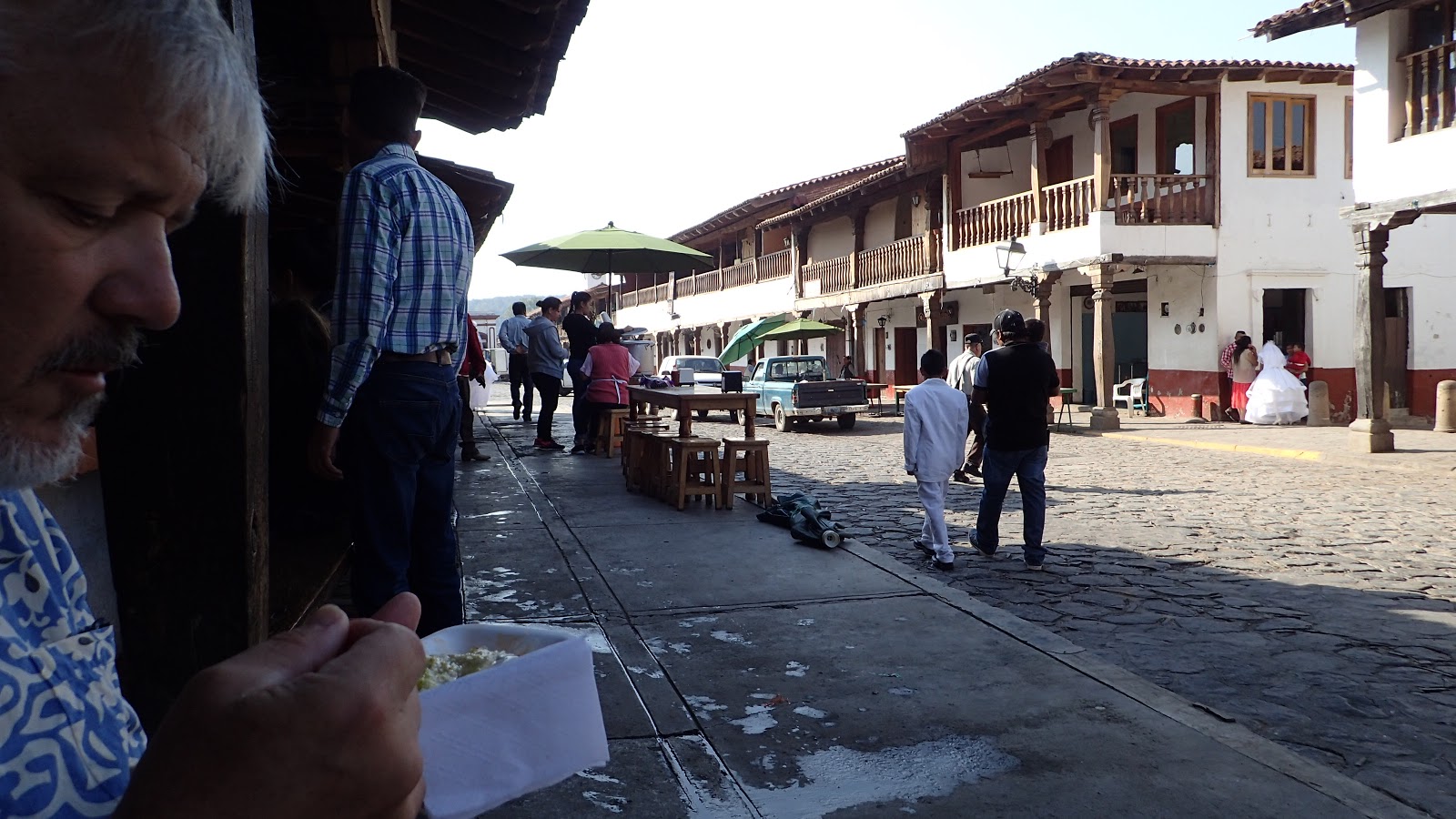
On Saturday morning we walked to the plaza in search of breakfast and ended up with a couple of tamales from a street vendor. We ordered one carne and one dulce (sweet), but Mark’s dulce was heard as doce (12), as we figured out, when they put 12 tamales in a bag! Everyone laughed, no harm, no foul. After the (2!) tamales we watched about 50 kids walk into the church for confirmation, the boys in white suits, and girls in beautiful, fancy white dresses. Did we mention we love Mexico?  
Who are you calling a Sisy-phus?


We also stopped to see some large rock formations called Las Piedrotas.


Next stop was Sayula. The local history book says Sayula was a relatively important town of commerce until the early 1900s when the railroad bypassed the town. Sayula is large-ish, but tired. Their plaza is large, but the gazebo is in total disrepair.  Sayula is known for a famous x-rated ghost story, in which if you take the ghost’s gold, it can have its way with you. Yikes. Bright spots? There are 2. One is the Ojeda knife store, where the 4th generation of messerschmidts is making beautiful, functional, and collectible knives. Sayula is also home to Lugo Cajeta, maker of delicious cajeta (milk caramel), and owner of bragging rights for the largest cajeta ever (according to Guinness) – a whopping 3,162 lbs!!! [By the way, did you know that the Guinness Book of World Records was originally created as a reference for bars (selling Guinness natch) so patrons could have something other than futbol to talk about?]

We ate lunch in Sayula (local specialties…meh) and it turned out that a senate candidate, Pedro Kumamoto (like the Japanese oyster, great grandfather immigrated here, interesting Japanese Mexican history,) was in the bar, out of sight of the dining area. This being election season, and he being a reformer, we would have likely moved on had we known it! It turns out that we missed the life-size rendition of the aforementioned ghost in that bar, which we hope had nothing to do with current day politics.

On to Mazamitla, a Nahuatyl word which means “place with arrows for deer.” Which explains why almost all the souvenirs have the head of a venado (deer) on it. Mazamitla is renowned locally as an amazing and charming town (also a Pueblo Mágico). Its church is very different from most Mexican churches, and has gingerbread (sort of) features, and painted red and white, as is most of the town. Turns out it was built in the 1950s. We were lucky to see a wedding going on, lots of flowers, and mariachis.

This was a weekend, and on Saturday the plaza was literally overrun with “rich Tapatios” (people from Guadalajara). It was loud and a little unnerving. Filter feeders were out when the currents of tourists are in full force. Sunday was quieter, and when we drove out on Monday morning, the place was close to a ghost town (but not like Sayula!).


Our cabin
Mazamitla is known for “cabin” rentals – where city folk can rent a log cabin in the trees and “not-so-rough it.” Ours was packed tightly into a neighborhood of similar houses, but was cozy had a lovely back deck to sit and listen to the wind through the pine trees…reminded us of our home in the Oakland Hills (sigh).


Walk to the waterfall!
We hiked to the famous El Salto waterfall through a lovely residential neighborhood and an impressive switchback trail with fake “log” guardrails. The falls were lovely and peaceful, even with all the people there. 


 One could rent horses for the trip, or for the return there was a John Deere (Juan Venado?) tractor to take you back uphill. Tempting! A family with whom we labored back up the trail offered us a ride out of the neighborhood (uphill)...guess we looked tired?  Again, tempting! We felt righteous after the 2 hour hike, so had some nieve de garrafa ice cream, scooped out of a big bucket.
Maybe if it was an IH?
This cute little girl had the best route back up! 


jugo de zanahoria w/ a view?
Yum, bote
Monday morning we had breakfast at a place call La Troje (The Granary). It was a large, open room, walled with knotty pine. We sat in the “bar” area, delineated only by the back bar with bottles of tequila and the like, all part of the main dining room. On the walls, though, were many large framed posters of actresses in fetching poses, with “gripping” clothes. Ha! Linda had a spicy, meat-filled soup called bote, Mark had the Hot Cakes with a spicy view (and accidentally ordered a CARROT JUICE?)


We returned to San Antonio Tlayacapan via the scenic route, by way of the tiny village of Petatan. This town is known for flocks of pelicans, from US and Canada, that spend most of the winter here. Who knew pelicans migrate? We didn’t. They call them pelicanos borregones, basically meaning “white like sheep or clouds.”


TravelTiki confession
We drove on back towards Jocotepec, and made a quick stop in the small but bustling town of Tizapan El Alto. They had a beautiful church, and the ubiquitous, rainbow-colored “town name sign,” while there we bought a bag of fruit in the local tianguis (street market) for 15 pesos (80 cents). 


Saying "your tax dollars at work for you"
we don't need no stinkin detours
We also spent a number of miles on various dirt road detours, as much of the road is being widened and improved. It was a little unnerving to drive within a few feet of giant earth-moving equipment!

And…We returned in time to get celebratory anniversary martinis at Mama’s!


 (29 de mayo de 2018)