Showing posts with label Holiday. Show all posts

Saturday, April 28, 2018

Semana Santa

Ajijic, Jalisco, Mexico

Semana Santa, or Holy Week, is a major holiday in Mexico, maybe the major holiday, as many people take the entire week or two off from work and school to celebrate with family. And given that over 80% of Mexicans are Catholic, this time is taken very seriously. We were warned to get gas in the car and cash out of the bank before the week started as they often run out of both in our “resort” area.

Sorting out the timing of the various pieces of the whole religious story is a bit confusing, and shockingly, even Mark’s inundation in church for 18 years did not make it a lot clearer. There is Mardi Gras, the day before Ash Wednesday, the start of Lent. And Lent is 40 days (and then there is Noah and the Ark and rain for 40 days and 40 nights…gets confusing). All to say this report is to tell you about what we saw and experienced, without trying to ensure the concatenation of events is completely accurate.

You may recall Mark’s floury experience back in February at Carnaval in Ajijic (if not, you can find it on the blog). That was February 13. Fast forward through Lent (the best part of which was the capirotada bread pudding,) to March 25, Domingo de Ramos (Palm Sunday), which we called “Jesus on a Burro.” In Ajijic, they celebrate with a brief parade through town of the man selected to play Jesus for the rest of the week, on…. a real burro!


The streets are strewn not with palm branches, but with lovely green alfalfa. We were told it is readily available, cheap, and recyclable. Indeed, within minutes of the parade passing, pickups pulled in and were rapidly filled with the alfalfa, which was taken to feed livestock.

We were walking along the parade route looking for a good spot to watch and saw some other gringos on a rooftop in a prime position. Linda jokingly asked, “how much is a ticket?” and the reply was “cold beer.” We bought a few at Oxxo, came back, and indeed they invited us up. Turns out one of the fellows was from Holdenville in Oklahoma, so he and Mark had a nice visit. And Linda got great pictures.

Ajijic square on Palm Sunday

AND MORE confetti eggs!!


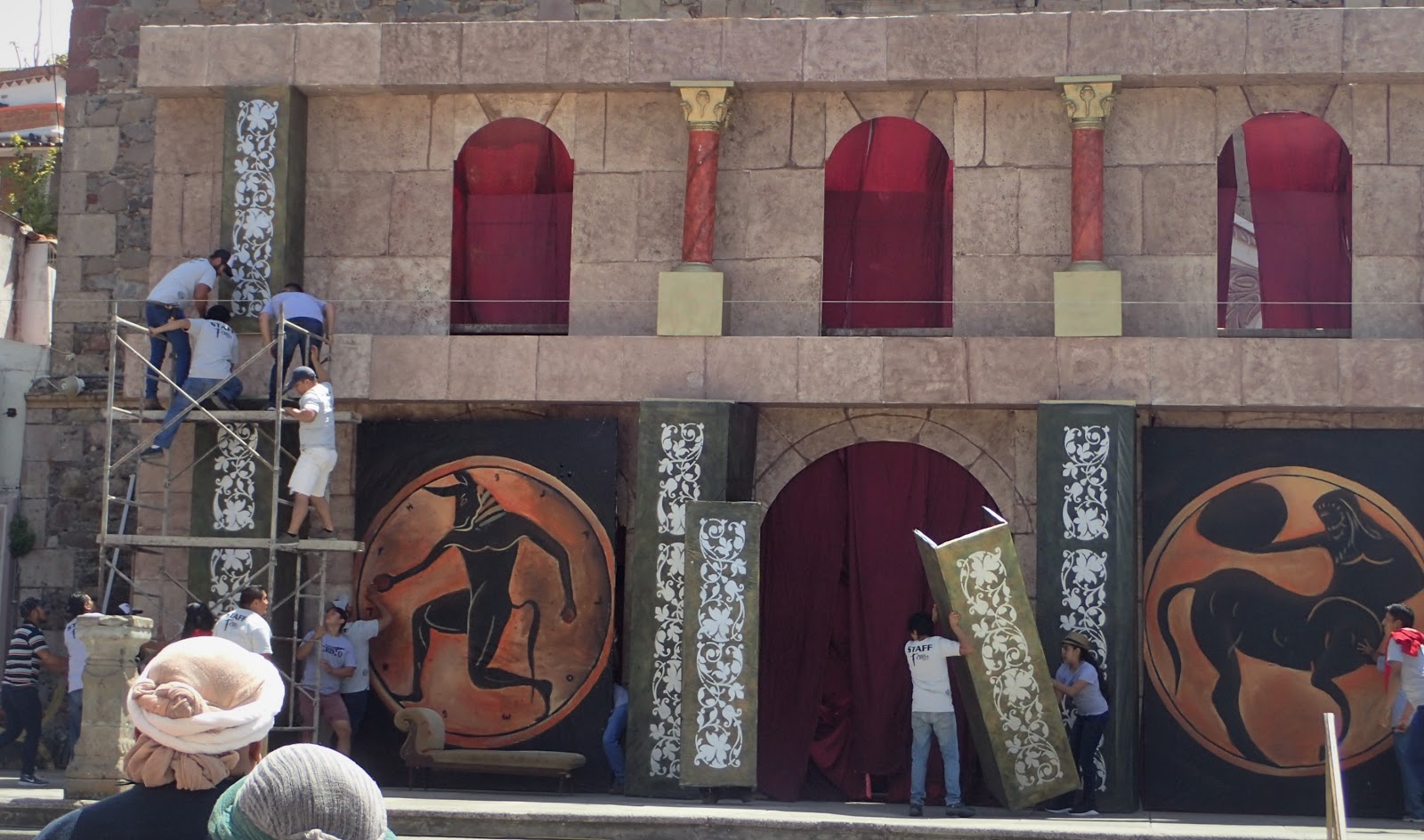
The Stage (curtain in front of the church)
On the following Thursday, there was a re-enactment of the Last Supper and arrest of Jesus, which we didn’t attend. The next day, Viernes Santo (Good Friday), we spent over two hours in the hot sun in the plaza area of the church, watching Ajijic’s version of the Passion Play, featuring Jesus facing judgement with first Pontius Pilate, then Herod, then back to Pilate.
OMG...actually starting on time???


Pontius Pilate, guards, and the crowd of actors
The drone was pretty annoying

As was the gringo actually SITTING in the middle of the actors in the play!! 


There were scene changes between these 3 main trials, and each took almost as long to change as the subsequent scene took to act out.


A lot of press coverage (at least they blend in!)

At the end of this part of the play, Jesus is whipped and then.....


....picks up a real cross and carries it out the gate and through town (followed by a crowd,) the up the neighboring hills (maybe 500 feet of elevation gain?) to Golgatha. Have to say the sheer brutality of what was being represented took us aback.  


Yes, it's really long....and hot...
  
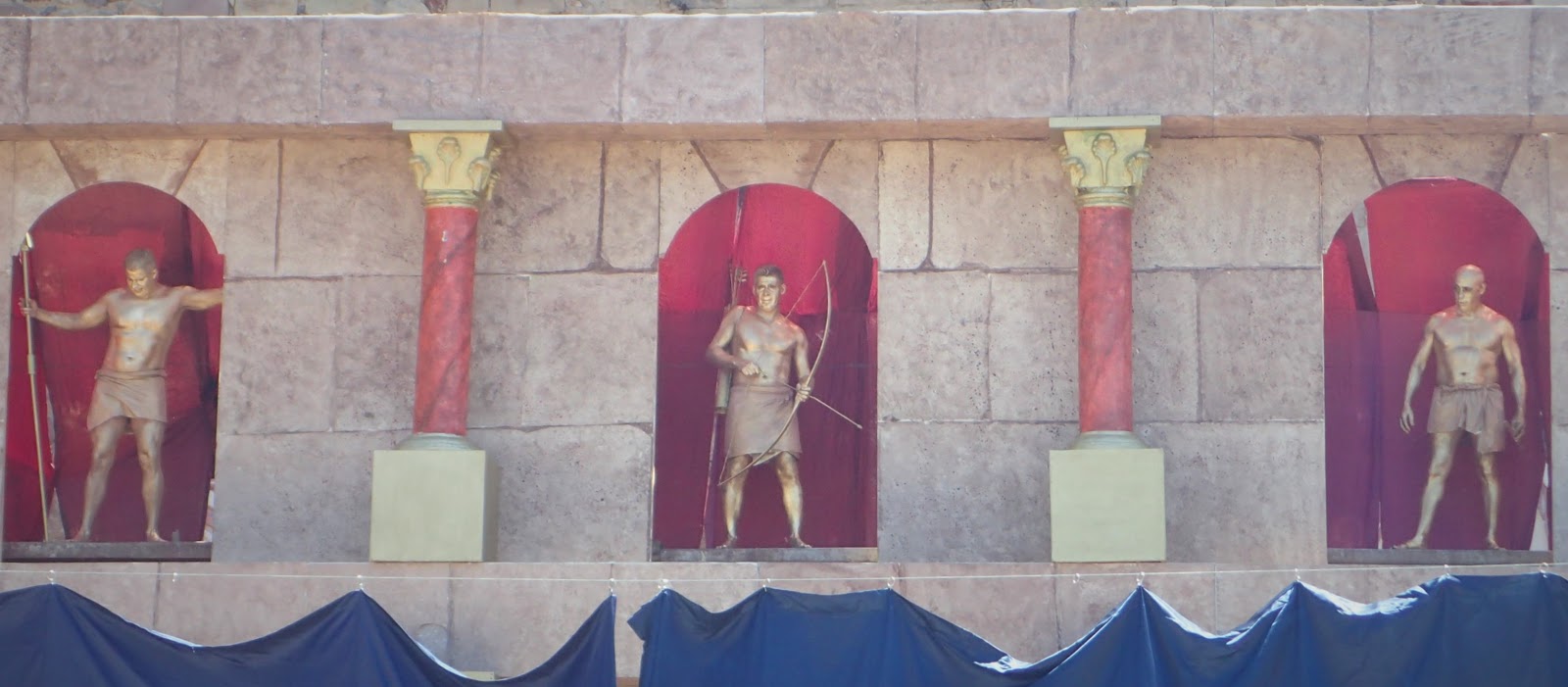
One stunning piece of this event were the people painted in gold who were statues in the scenery. There must have been 7-8 people, and which recalled 007’s Goldfinger.

Following Jesus to Golgotha


The "3 Judases" awaiting their fate
Mark decided to go out late on Saturday to see the Quema de Judas, and old Spanish tradition that is alive and well in some parts of Mexico. The version here involved several large paper mache people, each with a name on a sign around their neck, and which appeared to be local people, like say -- the Mayor. 


They were strung up one at a time in the plaza, and fireworks were set off, spinning wheels kind of like the castillos we saw at Christmas, whistling loudly, with sparks everywhere. Near the end for each figure, another set of fireworks were lit, spinning the entire figure in circles, culminating in an incredibly loud BANG, which left nothing of the figure except the frame. What a sight! The locals were laughing at how much Mark enjoyed this. (You can hear him hooting during the video)


And on Easter Sunday there were big celebrations everywhere. Not as many cohetes as we expected, though!


Now the “hot / dusty” season is upon us. We hear that things quiet down for a while with just the town patron saint celebrations. Our town’s is in June, which should be fun!


(abril 1, 2018)

Thursday, March 1, 2018

Carnaval

Ajijic, Jalisco, Mexico

Ever since seeing the Bahamian junkanoo scene in Thunderball, as Bond, James Bond darted and dashed away from the bad guys (International Spies from Russia, or ISR – oblique 2018 Olympics reference, about which Mark is grumpy…) we have been very curious about seeing a carnival celebration in person. They vary worldwide, from elaborate parades with thousands of celebrants (Rio and New Orleans), dancing, costumes, floats, and “local” themes (making fun of Spanish conquerors, as an example,) but all are based on the run up to Ash Wednesday, and the beginning of Lent – the season before Easter that includes saying adios to meat – hence “carne val” – put away the meat. ☹


For this pre-Easter season, there are many parades here, on multiple days (as usual!), and here in Ajijic, they mostly include masked men, some dressed as women, who are “taunted” by kids along the desfile (parade) route, and who respond by throwing harina (flour) and / or confetti on the kids. Porque? (Why would this be?)


The day before the final parade, this year on 13 Febrero, we went to a talk about the tradition of carnaval in the Lake Chapala area. An older local man told us many stories, mostly told to him by his abuelo (grandfather) many years past. It used to be, he said, that at the head of any parade, going all the way back to pre-Hispanic days in the early 1500s (!) there were always 2 characters, called sayacos. One is a woman and one is a man. This version of the story, and there are many variations, is that the two were brother and sister, gemelos (twins), and had a palsy-like condition which caused them to drool, and that sayaca means “water face” in Nahuatl. As the story goes, the sister, as she came of age, pursued the young men of the town, and as they fled from her, she grew angry and threw ground corn and flowers at them, which she carried in a shoulder bag.

Another pre-Hispanic tradition, co-opted by Catholicism, but stubbornly, and cleverly maintained through centuries by the indigenous people of Mexico. Viva Mexico!

Confetti 
Another key piece of the celebration is the papaquilistli. Originally, these were huevos de pavo (turkey eggs), the empty shells of which were filled with the bright orange petals of a local flower, called zempoalxochitl, which closely resembles the spirit-guiding marigolds of Dia de Los Muertos fame. The symbolism was that with this egg, you are giving the other person the best you have to give – not sure why. There are more than a few jumps to get from base fact to symbolic intention. That is one of the beauties of Mexico. Viva Mexico!

Constantly sweeping up flour and confetti
These eggs in modern times come from chickens, and instead of flower petals there is paper confetti – and sometimes flour. The eggs are broken on the heads of celebrants, confetti galore. Good clean fun. You can buy a bag of 10 on the plaza for 10 pesos (50 cents)… and annoy your gringo friends!
Mark had about 1/2 pound of flour on him
If you ask people about the significance of the flour, and confetti, you get many answers. Getting rid of the “bad,” which sounds like Catholics trying to co-opt the tradition. What became clear to us as we listened to the talk was that this tradition, which appears to be very specific to Lake Chapala, needs a historian to sort out at least the variations of the story. Mark as been experimenting with StoryCorps, and this might turn into some kind of help for the effort.

As always, there is specific food associated with the holiday. Linda jumped the gun a little by making capirotada (Mexican bread pudding) a few weeks ago before Lent started, when having friends over. No eggs or cream are involved, but spice-infused syrup, raisins and 2 cups of CHEESE were!  Odd, but very tasty – in fact too good to be a Lenten dish, really.  Here’s a recipe: http://muybuenocookbook.com/2011/03/capirotada-mexican-bread-pudding/


More fun than the Super Bowl!


(febrero 14, 2018)

Sunday, January 7, 2018

Christmas in 9+ days -- La Posada, Ajijic, Jalisco, Mexico


Another novena! This time for the 9 days leading up to Noche Buena, aka Christmas Eve. Noche Buena is also what they call the poinsettia here; the flower (which is actually a multi-flowered shrub) is native to Mexico, and was brought to “poinsettia” fame by a U.S. Ambassador to Mexico in 1822 – named…Poinsett. Noche Buena is much easier to day, and much easier on the ear.


Decorations of balloons and moss
The fiesta is called La Posada (The Inn) and is another re-enactment, this time of Maria y Jose looking for a place to stay in Bethlehem. For 9 evenings, each night in a different neighborhood -- groups of kids, parents and abuelas/abuelos march to a designated home. The people of the house sponsor the evening’s events.

Maria rides on a burro, lead by Jose. They are preceded by a few kids dressed as angels, and followed by a small vignette of the pair, with burro, on poles on the shoulders of some of the older kids. And then they are followed by the aforementioned children and families. The one we observed had at least 200 kids in the street.


As the procession reaches the sponsoring home / gate / door, the puerta is closed, and the assembled crowd in the street begin to sing a traditional song, first the kids outside, then a response by the people inside. The gist of the song is simple – we are poor pilgrims from Nazareth, please let us in / no, we have no room / but please, this is Mary, the mother of God. And so on. It is a lovely little song, and has many verses, including one which translates roughly as “go away, you may be a rascal and thief and I will have to beat you.” Awesome.


Eventually the problem resolves when the innkeeper recognizes that this is THAT Mary and Joseph, and welcomes them in (to the inn). Come in! And have gifts! And candy!
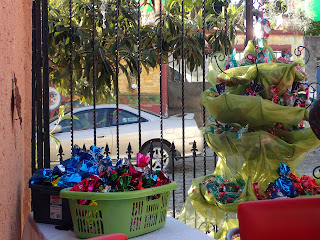


 A lot of gifts!
The formalities taken care of, the kids crowd in for the real incentive (we think) for this event – candy and piñatas. Each child gets a small bag of candy and treats (one wonders if dentists sponsor all of these evenings!). 

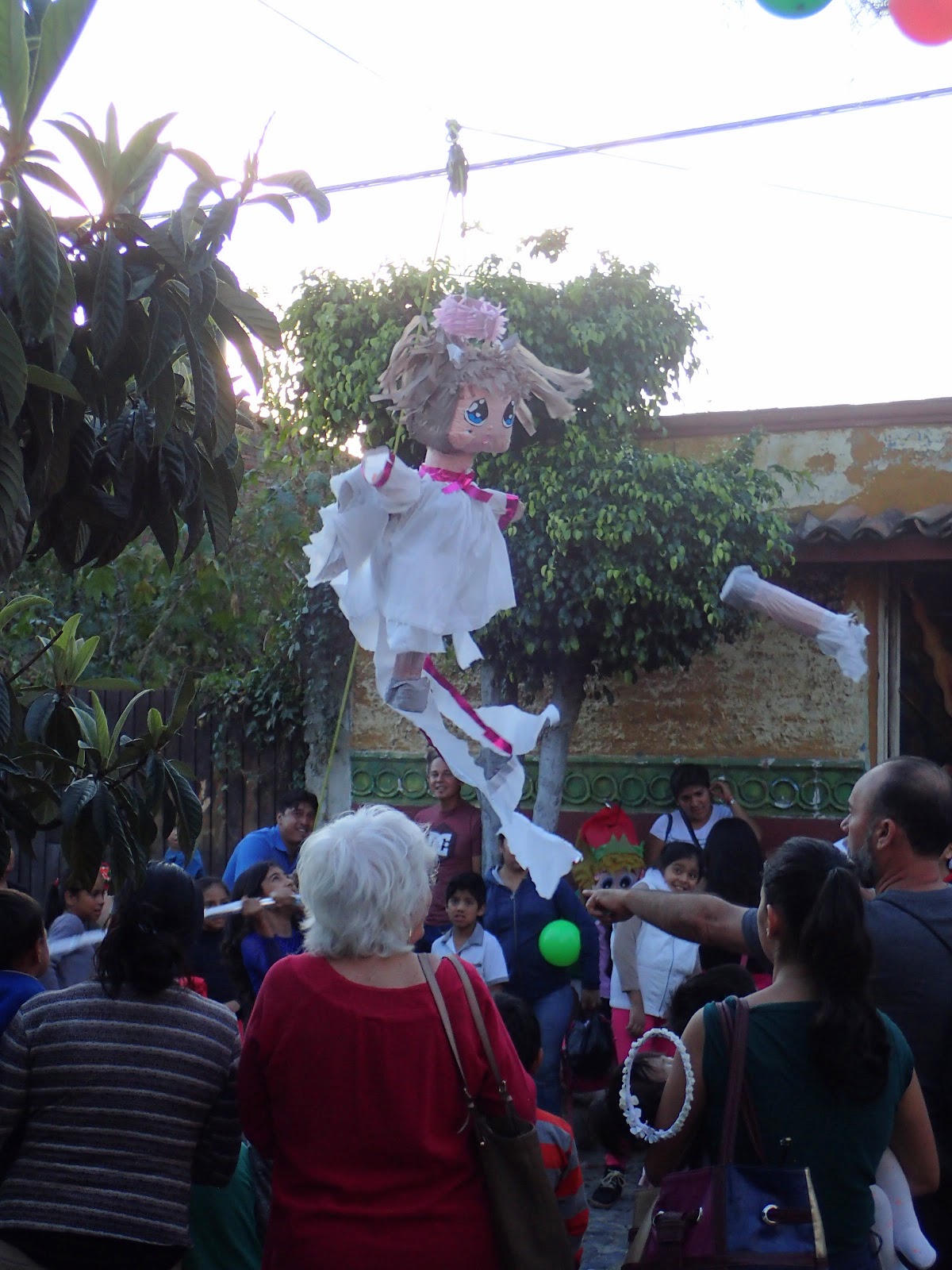
Then 3-4 piñatas come out, and one by one are demolished by the kids, while they sing “Da le! Da le! Da le!” (rhymes with last name of Salvador), the traditional piñata-bashing song. The ones we saw included an elf (take that, Keebler!), Santa (ouch!) and an angel (really?). Mark speculated that a nun with a ruler would be a more appropriate target for these kids than an angel, but hey -- we’re new here.


These Posadas go on for 9 days, and on 24 de Diciembre, an actual baby joins as part of the creche in Ajijic, the zocalo. Here, and in some other areas of Mexico, is it thought the baby Jesus brings the gifts and they are opened on Christmas Eve. In areas closer to the U.S., it is Santa Claus and December 25. Oh, and wait, the whole Christmas thing isn’t over yet…Some say the 3 Kings bring gifts on January 6, and if you get the baby in the King Cake, you bring the tamales on Candlemas Day, February 2! That seems a fair trade.

All in all, another look at a different way to celebrate Christmas, here on the fun side of the ($18 billion) wall.

(Diciembre, 2017)

Fiesta de San Andres, Ajijic, Jalisco, Mexico


We learned recently that most (if not all) towns in this area have the name of a saint preceding the Indio name. We live, for instance, in San Antonio Tlayacapan, which is called San Antonio. Sometimes the Spanish is nicer to hear, sometimes the Indio word is better. Good example – hummingbird. En Espanol, el colibri, in the indigenous (Nahuatl) tongue, huitzitzlin. In the indigenous language, Nahuatl, version as it is very…onomatopoeaic? Say it out loud.

But this is all about San Andres, the saint attached to Ajijic (ergo San Andres Ajijic, which is called Ajijic). If you were paying attention in Sunday School, you will recall that Andrew was known for being first a fisherman, then a Fisher of Men, so he is a good fit for a town on the shores of a lake. The feast day of Saint Andrew is November 30, and of course there is a novena (9-day fiesta) leading up to that day. And on each of these 9 days the cohetes, pop bottle rockets on steroids, start near dawn, lit in the hand and released to the sky, carrying the prayers of the faithful that much closer to God, with a loud explosion to get His attention!
St Andres church steeple against the hills
Today's fiesta brought to you by professionals, domestic employees, teachers, beauty workers, the businesspeople of the Port of the Lake, hair cutters, and JOE's.


The parade through town included vignettes from the life of the Saint, as well as miracles (like the loaves and fishes), re-enacted on the back of small flatbed trucks, and each float was sponsored by local groups, including Joes Barber Shop. One had San Andres, with nets, catching sinners. 


And the loaves and fishes – with real loaves and real fishes!


There were also Indio dancers, in feather regalia, and cool seed pods (need to figure out what they are) on their legs that make a great rattling sound as they dance.

That's a real dove! yikes!
But the highlight of this celebration are the castillos, one each of the 9 nights, erected in the plaza in front of the church. A castillo is a large structure, maybe 50-ish feet tall (though they can be much bigger), laden with various Catherine wheels (another saintly reference), each holding fireworks galore. The rockets on the edge of the wheel make it spin. Each night one is sponsored by some local group, the teachers, the municipal employees, etc. We chose to go to the one on the last evening, sponsored by the Hijos Ausentes, the “sons” who went to the US to work and send back money to their families. It is the grandest of the displays, since they have the biggest budget for fireworks, and music.

We were not disappointed! Each of the 7-8 spinning contraptions is lit one at a time, each with a theme or design. This one started with the face of Donald Duck (whistling rockets, and a spinning face), then Mickey, then a large chalice with two hands holding it. The grand finale were the words Hijos Ausentes, sparkling and raining sparks everywhere.

In the midst of these towers, several young men climb up inside, to ensure proper operation, (??) and maybe to be sure each wheel gets lit. They were so close to the rain of sparks that we were sure they had on some kind of fireproof clothing. Silly us! When we saw these fellows after the event they were just in jeans and hoodies. We heard somewhere that the daring component with fireworks is proof of their faith. If so, they had a lot more than a mustard seed’s worth! (sorry, haven't figured out how to rotate the video. But you'll get the point.)

Between each “castillo wheel” being lit, there were more fireworks sent skyward, launching from the ground maybe 40 feet from where we stood. The thundering launches were impressive, and kept startling us into jumping a little. Safe to say we have never been that close to fireworks of this magnitude, and more than once felt a sting on exposed skin where the remnants drifted down on us. We patted our hair each time just to be sure!


The main town has most of the streets shut down for booths, rides, games of chance, and music!


Mark suggested they should sell t-shirts for this saint's day that say "It's not my fault!" (A joke for you Californians and geology fans out there,) and like many such suggestions, it got no traction here, alas.

And so ends yet another fascinating cultural snapshot from Mexico -- the fun side of the wall!


(Diciembre 2017) (Sorry for the tardy publishing, I'll blame it on the shoddy internet!)