Showing posts with label Wildlife. Show all posts

Saturday, May 16, 2020

Thailand Part 2: Chiang Mai & Rai

SE Asia, Thailand, Chiang Rai and Chiang Mai


Chiang Mai


Merry Christmas from Thailand
Chiang Mai, in northern Thailand, is a city of about 250,000 people (though some Google results say 1 million...), and it makes many of the lists of places to retire. We will discuss our impressions of it as an “expat haven” in a separate post. We spent about 7 weeks between Chiang Mai and another northern town, Chiang Rai, over December and January. We took a “VIP” bus from Bangkok to Chiang Mai, about 5 hours north, for $10. The VIP part meant a bottle of water and a snack. And air conditioning. 

In general, we are "slow travelers" -- meaning that we prefer to stay in each area for a goodly amount of time, rather than running from place to place covering  as much ground as possible. "Normal travel" has become too tiring as we get older. AND TOO expensive! We usually get a better deal on longer rentals (Airbnb, VRBO, etc.)  and can cook at home.


A very fancy mall!
But it can be a challenge determining where you should base yourself when you don’t know the area. Based on reading some expat stories, we initially chose an area in Chiang Mai called Nimmanhaenim. Well, what we DIDN’T know was that it is mostly newish construction without much character, and appeals to Chinese tourists. A LOT of them. Because of the shopping. We are not big shoppers. Don’t get us wrong, our apartment was modern and nice, and the mall was great, with a good grocery store, a cool Japanese “dollar store” called Daiso and lots of food options. When we returned to Chiang Mai after our Chiang Rai excursion, however, we spent a little over a week on the northern edge of the walled Old City, which was MUCH more what we were thinking of…a place where real Thais lived, that had a Night Market nearby, and the ability to walk to see and do things.
We three Kings of Thailand are


Chiang Mai (meaning "New City" in Thai) was founded in 1296 as the new capital of Lan Na, succeeding the former capital, Chiang Rai. The city's strategic location on the Ping River (a major tributary of the Chao Phraya River) and its proximity to major trading routes contributed to its historic importance. They also moved south from Chiang Rai to put some distance between themselves and Myanmar, which invaded with some regularity.
With so much time here, 
Sticky rice dessert, colored with "butterfly pea flower"
we took a walking city tour, a street food tour, and a cooking class. “Noodle” taught our excellent cooking class at Yummy Tasty Thai. [Our cooking teacher in Vietnam used the name Pineapple.] Noodle was an excellent, organized teacher, even Linda learned something. We each got to choose what we wanted to make. We should have brought “take away” containers – there was too much food!
City market
Rather outstanding braised pork leg! from
the famous cowboy hat lady


Chiang Mai is the home of our new friend, Larry, a retired expat who taught school at several locations in Asia with one of Linda’s friends from Othello. The Othello Mafia remains strong, its tentacles are everywhere! Larry is from Texas, and despite teaching all over the world for some time, the Texas has not left the boy. He has an endearing Texas drawl (made Mark a little homesick, even if it was Texan). Larry has been in Chiang Mai for about 10 years and knows it quite well.

Larry has an enduring interest in the many wats (temples) that saturate Thailand, and Chiang Mai in particular. He especially enjoys finding the obscure ones where few people visit, no tour buses, just a peaceful stroll around the buildings. He very kindly showed us many of these finds, and it was a real treat to have him as our guide.


KHAO SOI!!! Our new obsession
Larry also shared a few restaurants with us during our travels, our favorite being Khao Soi Khun Yai (Grandma’s) and its killer khao soi. You get a big bowl of wheat noodles with chicken usually, covered with a spicy red-colored coconut milk curry, topped with those same wheat noodles which have been fried to a delicious crispiness. Pickles and hot sauce and shallots on the side. When we say spicy, we mean Thai spicy, which we mostly became accustomed to.


Chiang Mai has many good restaurants, probably driven by the throngs of tourists and expats.


Napoli in Thailand!
Interestingly, a couple of our favorite places in the Nimman part of town were Italian. One was a place named Pizza My Heart which was inspired by the San Francisco pizzeria. It had a real wood-fired oven (more on that topic in the eventual Phuket post) and another spot with very good lasagna and bolognese and a charcuterie plate that rivaled any place we have been. OK, maybe not France or Italy, but close! Why Not? (That's the name of the restaurant....) We’re sure there was also a little “absence makes the heart grow fonder” involved. But they were quite good and we returned several times.


Yes, that's cricket on the telly. And Mr. Clear.

Alcohol is not a bargain in Thailand. An acceptable bottle of sauvignon blanc at a restaurant was close to $20, maybe reasonable in California but pricey compared to $2 beers (and Mexico prices!). One exception to this rule was something they call a “set,” a word frequently seen on menus to describe some kind of combination like soup, noodles, and dessert. At some places, (including our favorite Irish pub!) the drink set was a ½ bottle of Thai rum, called Sang Som, two cokes, 2 glasses, and a bucket of ice (with tongs!) on a tray, all for 375 baht (about $12.50). Whenever we saw this, we ordered it, and immediately were recognized as the Party Table.


We also liked a place called The Writer’s Club, with excellent som tam (green papaya salad), and something called dried pork, which was basically chewy and crunchy fried pork belly. Get in my belly!

Crispy pork and sticky rice

We also made a few excursions while based in Chiang Mai. One was to an elephant sanctuary called Elephant Nature Park, 1.5 hours north of town. There are a lot of ways to experience wildlife (elephants, tigers) in Thailand, and some are more humane than others. Elephants are the Thai national symbol, long associated with Thai royalty, and it is said the country is shaped like an elephant’s head. They have traditionally been working animals as well. 


An adult Asian elephant can eat 300 lbs (!) of vegetation per day, and with habitat loss and human presence making roaming in the wild unlikely, elephants that are not “pulling their weight,” so to speak, can be neglected and mistreated. Even working animals may be “trained” using chains and elephant hooks to control them. The sanctuaries run the gamut from real sanctuary (no work, plenty of food, veterinary care) to more forced interactions with humans, including washing them and riding them. We chose one that allows elephants to live out their days, contained in a very large area but treated well. Our interaction was to feed them fruit and vegetables - the dexterity of their trunks is phenomenal - and also walking amongst them with a guide who kept us at a distance most of the time. We watched them eat corn, too, they love the ears, but eat the entire plant, stalk and all. An amazing experience, they are so - cool! Pretty descriptive, eh? When they trumpet, it is like 4 or 5 different tones all at once, and it shakes your core. What a creature!


Sadly, we just read (early May 2020) that with the absence of tourists paying a lot of money to go see them in Thailand due to coronavirus, some were being released to the wild, since feeding them is expensive. This could be a positive if they can adapt and be left alone.


Ladies tying off the thread to dye another color
REAL indigo dyed thread


Another trip was to a working textile shop called Studio Naenna, founded by a British woman who came to the region with the UN in the 1970s and in the late 1980s founded the Studio as a cooperative to support women weavers, making “high quality, ethical and environmentally sustainable products.” Watching how they prepared the yarns for weaving into the ikat fabrics was mind-boggling. 
Indigo dye is actually fermented
They tie off and dip skeins of yarn in various colors to only color certain parts of the yarn, repeating the process to make the completed yarn, THEN they weave it to create the patterns in the ikat fabric. So when you do the dyeing you have to know which parts to color which color. It was as amazing as watching the Space Shuttle launch and wondering how in the world they figured out the process!


We visited a few museums of culture and Hill Tribes to try to learn more about the Thai people.
Mien dress


One very interesting cultural component is textiles. The various tribes have their own styles and color schemes. There are for instance Blue Karen and White Karen, so called due to their clothing. The variety and craftsmanship (craftwomanship?) of these textiles, made with the most primitive of tools, is stunning. It reminded us of the textiles of Mexico’s Oaxaca, where many remote groups also have their own distinctive styles and patterns. It makes you think about all these remote and unconnected groups all over the world and the source of their inspiration and creativity for something (fabric) that is functional, but also so colorful and beautiful, and with cultural significance, well beyond basic functionality? We’re glad they did, and do. [If you are curious, go to this Mexico City post, with the pictures from the Museo Arte Popular. A good picture or two of Mexican textiles. There is also a great textile museum in Oaxaca.]


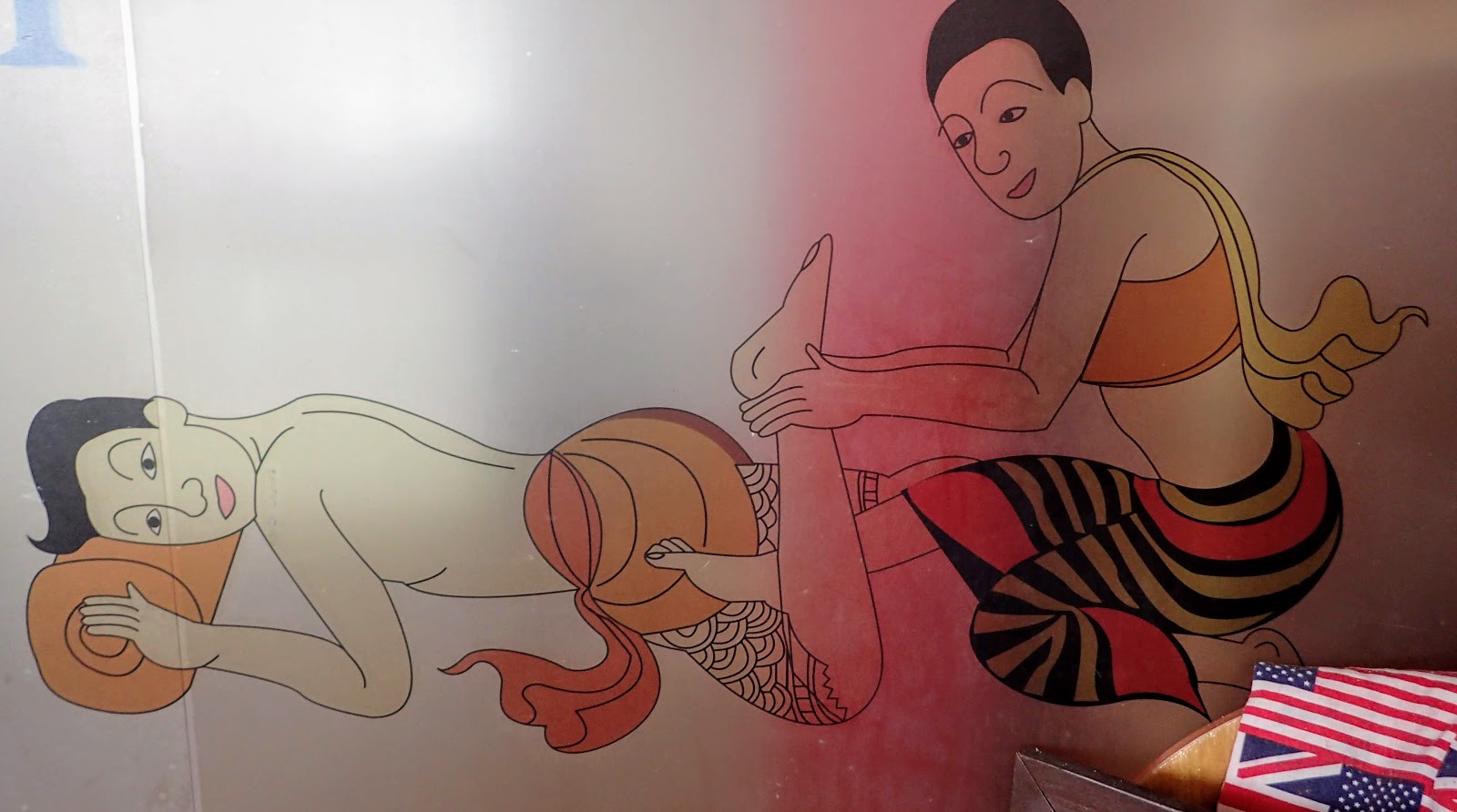
Mark also tried the ubiquitous and famous Thai Massage. It was 300 baht for 1 hour ($10 USD), and it was impressive how a small woman used her body weight and leverage to stretch and turn to relax the muscles. The one we patronized was known for teaching women from the local prison to have employment. While he's not a big massage person, this was quite …relaxing! (and did help his back.)  Linda got a facial instead, not wanting to be pulled and pummelled.


Thai massage is a little different!


Chiang Rai


The bus had a display! and a game console! (not operational)
We took a “road” trip to Chiang Rai, a 3.5 hour, 200 km bus ride on the Greenbus ($12). It was interesting to ride through forests, see a few elephants walking along, and less interesting -- LOTS of road construction. We disembarked at the wrong bus terminal, Terminal 1, since we did not know there was a Terminal 2, which was a 100-yard walk from our hotel. But we got a truck taxi (300 baht, $10) and all was well.


Golden Triangle
Chiang Rai is in extreme northern Thailand, near Laos and Myanmar (Burma) and the Golden Triangle, (in)famous for its role in the opium trade. It is also very near where the Thailand Hill Tribes live. The most recognizable names of these tribes are the Karen, and the Hmong, two of about 10 ethnic groups who are not Thai, nor are they Thai citizens. They are subsistence farmers, using slash and burn farming techniques. 

The stunning White Temple
Ganesh pavilion


Yes, Terminator and Dead Pool
As we usually do, we booked a 1-day guided tour around Chiang Rai for orientation and some local knowledge. We visited the White Temple, built in 1997 by Chalermchai Kositpipat, a well-known Thai artist. We had been going mostly to old temples, and seeing a “modern vision” was  engaging, and the site was visually stunning. Inside the main temple building were modern murals  featuring startingly current scenes and characters  – the twin towers, Spiderman,  Hello Kitty, Batman.


By E2v - Own work, CC BY-SA 3.0, https://commons.wikimedia.org/w/index.php?curid=33652683


We also went to The Golden Triangle (intersection of the borders of Thailand, Laos, and Myanmar, at the confluence of the Ruak and Mekong rivers. And visited the Opium Museum (not much to see and a bus of coughing Chinese folks, so we exited quickly). 


Two for tea

We visited a tea plantation (beautiful but a bit light on content).  


The northernmost point in Thailand where we could see Myanmar and the steady flow of people back and forth.


The Black Temple which was actually not a temple, but the compound of an artist with a taste for animal horns, bones and skins.  


The Blue Temple!
Our favorite was the last – the Blue Temple which was surprisingly peaceful. Another modern temple created in 2016 by a student of the White Temple artist. We found that blue is indeed calming! 


A feature of this tour that we were both curious and wary about was a visit to the “Karen Village.” The Karen are known for the practice of using heavy brass rings to elongate the neck of women. It turns out to be an optical illusion of sorts - the necks are not elongated, but rather the clavicle is deformed downward. The “village,” however, was what we feared - crass exploitation of this “curiosity.” The few vendors in the village do the hard sell, of goods that look to be mostly from China, not handmade by villagers. Even the little kids know how to work the tourists - cute smiles, fake hugs for pictures and money. We tried to rationalize that at least the people, with little other way to earn a living, were benefiting from the pricey admission fee ($10, a lot for Thailand). 


The little pineapples are a specialty of Northern Thailand
But a little investigation indicated this was a false hope. If you are presented with this “opportunity,” turn it down. Don’t go. 


The only positive part were the tiny sweet pineapples on a stick, craftily carved for eating, for a dollar. And that was in the parking lot.


Near our hotel was a coffee shop called Prompt Cafe that was roasting their beans in very small batches, it was sooo good. 


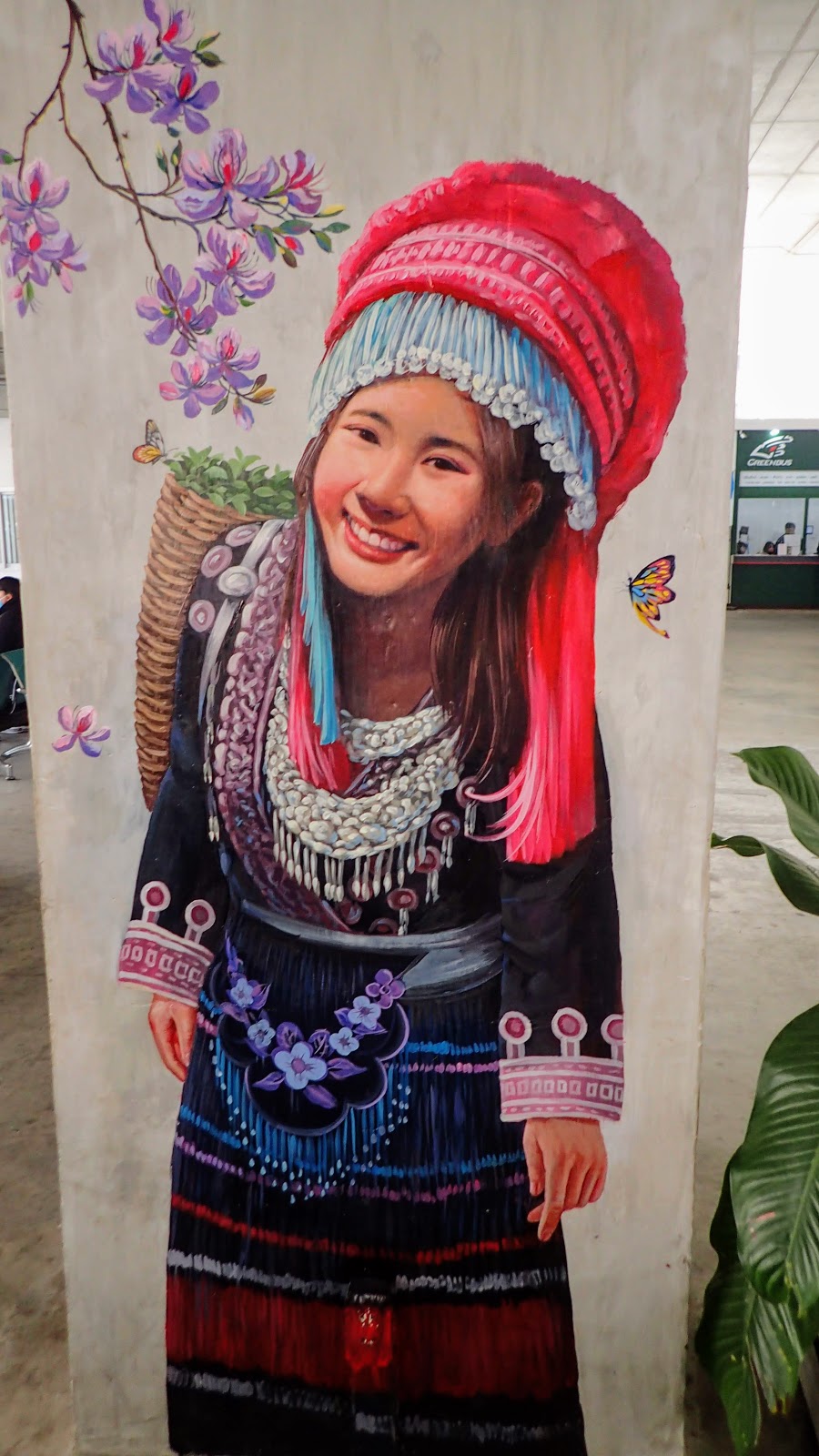
We did find the “main” Chiang Rai bus terminal for the trip back to Chiang Mai. It had beautiful murals throughout dipicting the Chiang Rai area and hill tribes.


Next -- Kuala Lumpur, Malaysia!


2020 21 Dec to 5 Feb 

Sunday, January 27, 2019

Oaxaca Beachside: Puerto Escondido & Hualtulco

Oaxaca state, Mexico


Cozy!
After a delightful month in Oaxaca (City), we headed south and a little west to the Pacific coast, still in Oaxaca (State). We took a short 30-minute flight in a tiny airplane over the mountains (unfortunately shrouded in clouds), starting our coastal tour in the surfer town of Puerto Escondido. We stayed in the small village of Brisas de Zicatela, just south of Zicatela, which is known among surfers as the Mexican Pipeline, a very large tubular wave that is at its peak in the summer. We don’t surf but have read that this area is one of the Top 10 surfing destinations in the world.

Downtown Brisas de Zicatela
We checked in to our lovely Airbnb studio apartment and headed into “town,” which is mostly a packed sand road with restaurants, hostels, dogs, bars, a couple of Oxxo-like tiny tiendas, an organic market, and a tiny vegetable stand where they sold, along with the produce, ½ pound bags of pasta for 7 pesos (33 cents). 

We found one restaurant, run by an Aussie, where they had tasty meat pies … well, they sort of had them… since they were on the menu, but they were not always available. Once we had tried, and liked them, we asked the proprietor if we could order (and pre-pay for) a half dozen. Oddly, she said “no, I want to have them for my restaurant customers.” Which we thought we were. Anyway, we made a couple of runs at changing her mind, and she just dug in. Odd.
...no more pie for you!!


I love you, man!
Look, Marky likes it! he ate a corn tortilla!
The good news, though, is that we found a fish taco place, right off the beach, called Pepe’s. It was hidden away behind palm trees and foliage, sand floor, and 3 dogs in residence – 2 brindle hounds and a pit, all very friendly, despite the “perro peligro” sign on the gate. Pepe is a character in all senses of the word. He serves what he has, and if more people show up he heads out for a few minutes to get more fish, tortillas, booze, etc. We went 3 times in 15 days, because his coconut fish tacos were inspired by angels. Pepe also will take you on a fishing trip which transitions to a cooking class for his said heavenly coconut fish tacos. Next time! That said, we went 3 times!
Cue...angels singing


Turtle traffic jam

We connected online with a nice mexicana, Gina, who moved from DF to Puerto Escondido maybe 20 years ago. She was hired by the local government to run a tourist information booth and did so for years, until the government shut down her program. The good news is that while they quit paying her, they allowed her to stay in the booth, on a main tourist street, rent free, and she made the most of that – she is still there and goes by the moniker “Information Goddess.”
We went on a nighttime “turtle trip” with her and saw 80++? (It was DARK) Olive Ridley turtles coming in from the ocean to lay their eggs. There were so many we had to be careful not to get in their way, nor step on them. It was truly amazing.

Tiger Heron
Gina also connected us with a guide who took us in a boat into Laguna Manialtepec (which we think means “hill of springs” in Nauhuatl) for a birdwatching trip. This is not something we do regularly, but the laguna was so peaceful and calm, we might take up a new pastime. 

The laguna was like glass. We saw 40-50 different species, including a gorgeous tiger heron, and a peregrine falcon.


Drive along the coast to Huatulco
From PE, we took a local bus (2.5 hours, 85 pesos pp / $4 US) south to Huatulco, formerly known as Bahias de Huatulco, after the 9 bahias there. After the Spanish Conquest, Huatulco thrived as a port under Hernán Cortés' control serving as a vantage point for Spanish galleons and a distribution center for supplies on the Pacific coast. The latter half of the 16th Century saw Huatulco attacked by Francis Drake (per Wikipedia). In the 1980s, Mexico decided to develop the area of tourism, along the lines of Cancun.

yummm... tiramisu
We stayed in another Airbnb in La Crucecita, on the eastern edge of the centro area. Good restaurants, including an Italian place with some killer fresh pasta Bolognese and tiramisu. And a 3 course champagne brunch...sigh.


The largest Virgen de Guadalupe

For scale
The church on the plaza is relatively new, probably 1980s when the town was built up. The church is stunning. In the cupola of the church is painted a 20 meter tall image of the Virgin of Guadalupe, which is the largest in the world. It is kind of like seeing Lupita on the ceiling of Grand Central Station.


There are beautiful beaches in Huatulco, though access was challenging due to the presence of the resorts that are a part of the tourism plan. We decided to walk in from the public access area, which was an interesting path through a swamp over boards, tires, and dog food bags full of cement. But it was free!


It is always fun to see the Mexican Christmas preparations which lasts for weeks... including a fun little parade of groups of elves, snowmen, ornaments and a star (sort of) leading the wise men. 


Also, leading up to the day of an important Virgin Mary in the area, there are groups of pilgrims actually running (wearing sandals or barefoot) from their homes to the festival church, really amazing.

Here today, barbecue tomorrow!

Also a cow moooved into the neighborhood and was very louuud. When one day it got quiet, Linda asked our Belgian hostess about the cow… it had become the main course at the church’s fiesta up the street!

Happy Holidays in Mexico!


20 diciembre 2018